



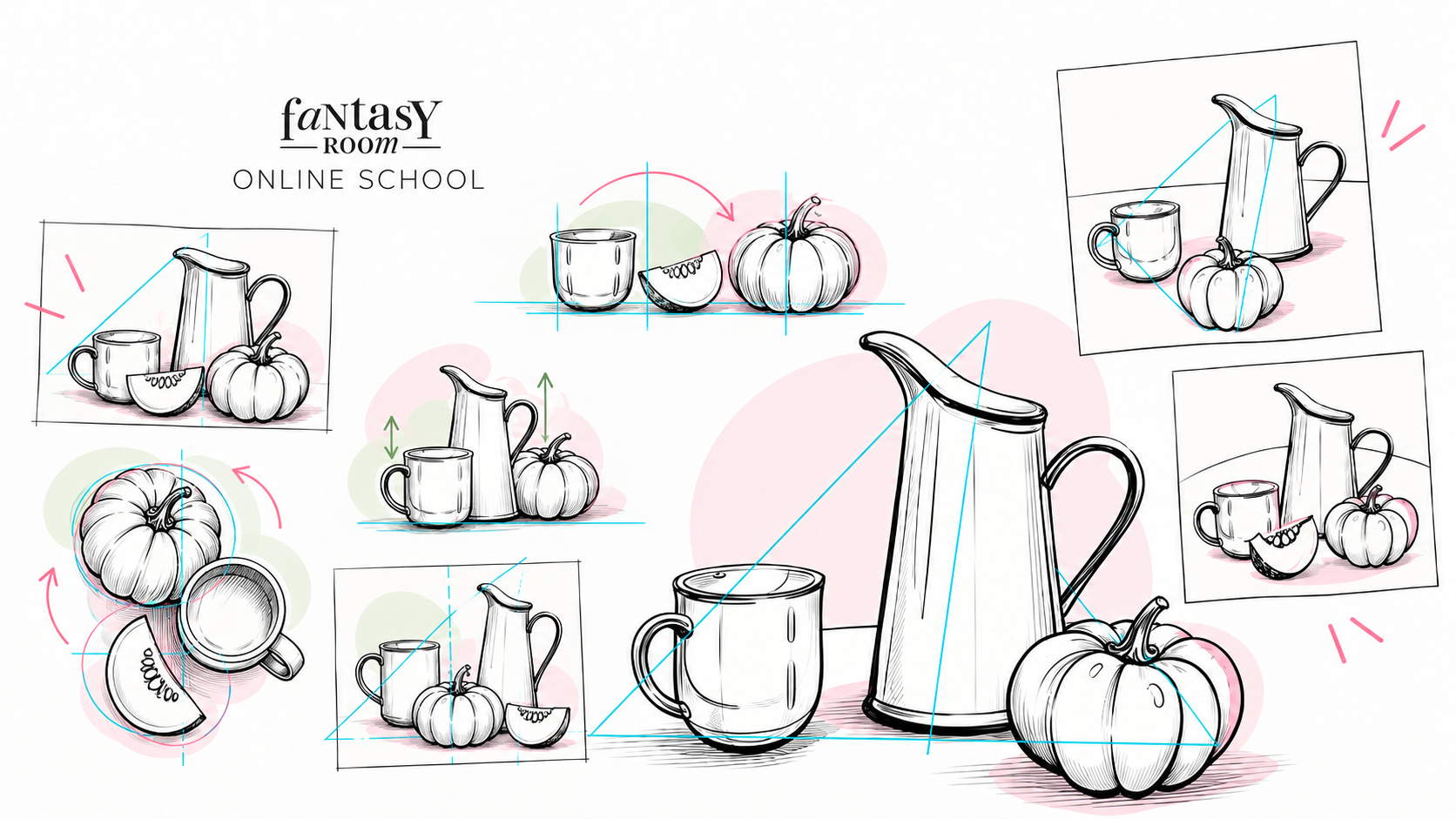
Even well-drawn individual objects do not always come together to create a compelling artwork. The reason often lies not in drawing technique but in composition: how objects are arranged on the page, how they interact, and where they direct the viewer’s eye.
Still life is particularly useful for exploring the principles of composition. Let’s take just a few simple objects—a pitcher, a cup, and some vegetables—and see how changing their positions can completely transform the character of a drawing.
Below are five techniques to help you create more intentional, harmonious, and engaging compositions. We’ll explore each one through simple still-life examples.
Quick answer: To make a drawing’s composition more interesting, use asymmetry, overlapping objects, grouping, and variations in scale. Avoid accidental tangencies between shapes, the edges of the page, and the horizon line. These techniques help create balance, depth, rhythm, and a more intentional still-life arrangement.
Contents
- Symmetrical or Asymmetrical Composition
- Separate or Overlapping Objects
- How to Group Objects
- Why Variations in Scale Matter
- How to Avoid Accidental Tangencies
- A Good Composition Checklist
- Is There One Correct Composition?
- How to Develop an Eye for Composition
- Drawing for Beginners Course
- Frequently Asked Questions About Composition
Symmetrical or Asymmetrical Composition?
One of the first decisions when planning a composition is how symmetrically to arrange your objects.
A symmetrical composition creates a sense of balance, stability, and calm. The objects visually balance one another, making the arrangement easy for the viewer to read.
A symmetrical composition creates a sense of balance, stability, and calm. The objects visually balance one another, making the arrangement easy for the viewer to read.
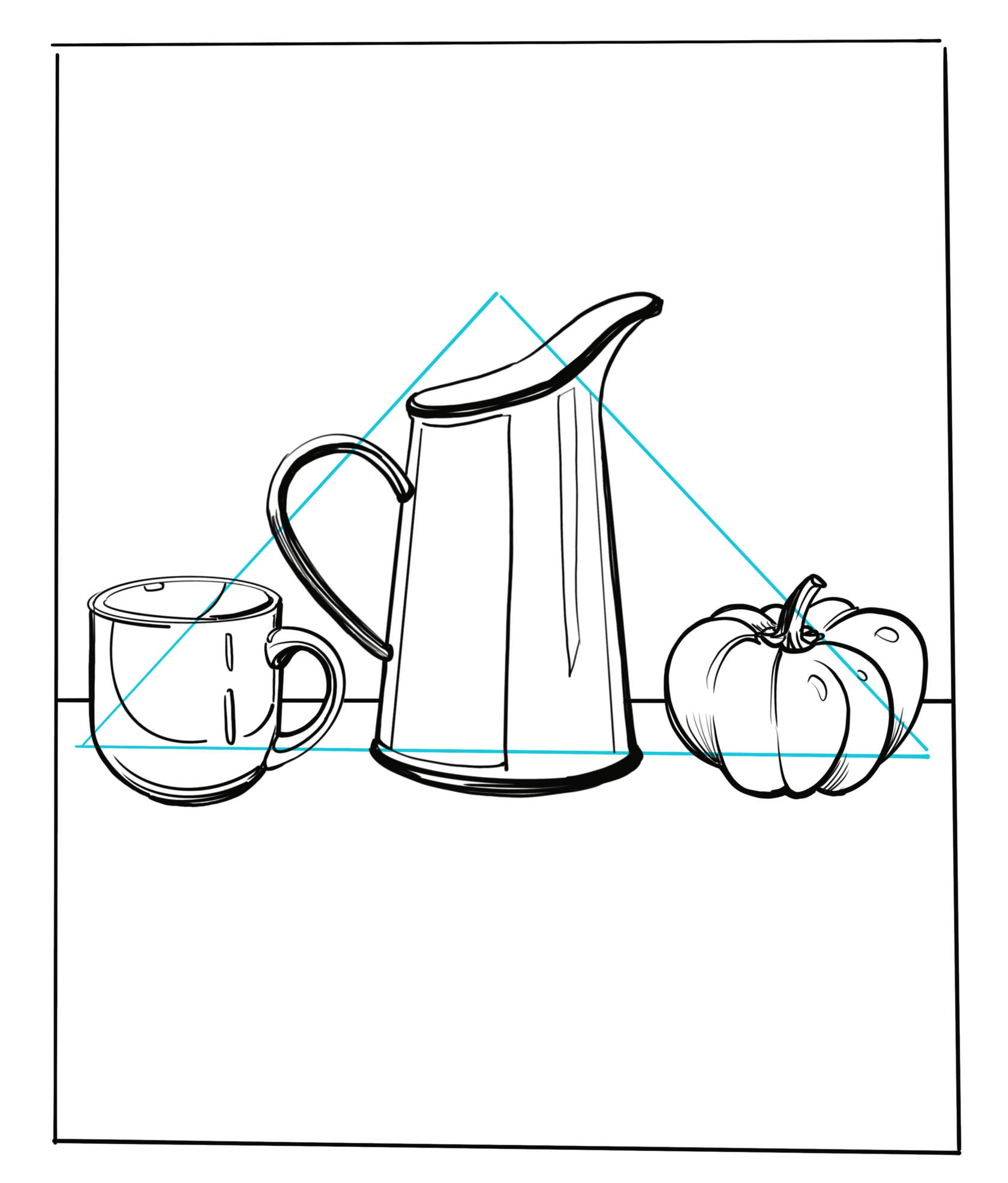
However, perfect symmetry is not always necessary.
Shifting the objects slightly away from the central axis makes the composition more dynamic. This creates a delicate balancing effect: the objects remain visually balanced, but the drawing no longer feels static.
Shifting the objects slightly away from the central axis makes the composition more dynamic. This creates a delicate balancing effect: the objects remain visually balanced, but the drawing no longer feels static.
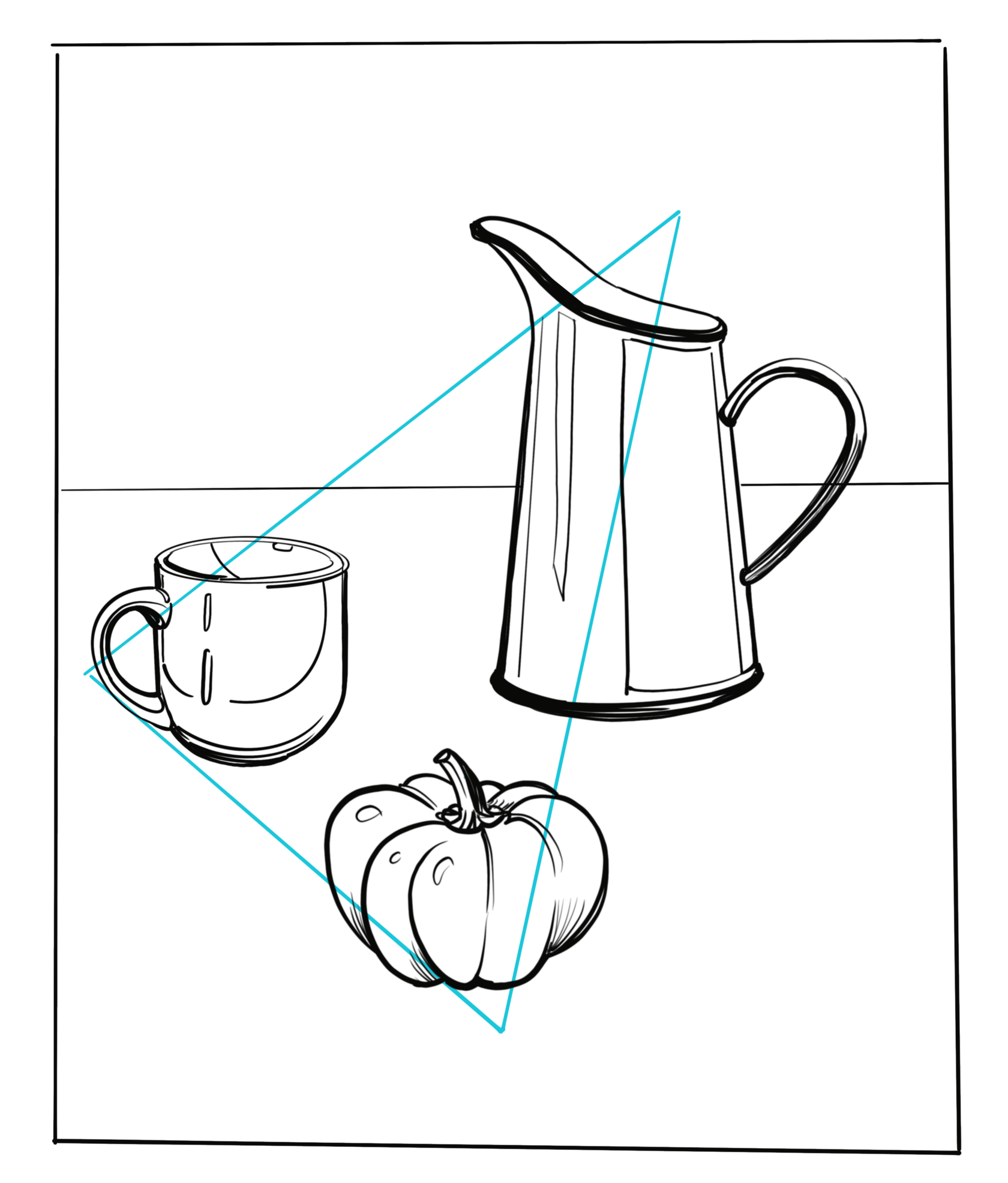
That’s why it helps to try several arrangements of the same set of objects before starting your still life.
Tip: Before adding details, make two or three small composition sketches and compare them.
Tip: Before adding details, make two or three small composition sketches and compare them.
Should You Keep Objects Separate or Let Them Overlap?
The space between objects also has a strong influence on how a composition is perceived.
Leaving enough space between objects makes the composition feel lighter and calmer. It gives the arrangement more breathing room, allowing each object to stand on its own.
Leaving enough space between objects makes the composition feel lighter and calmer. It gives the arrangement more breathing room, allowing each object to stand on its own.
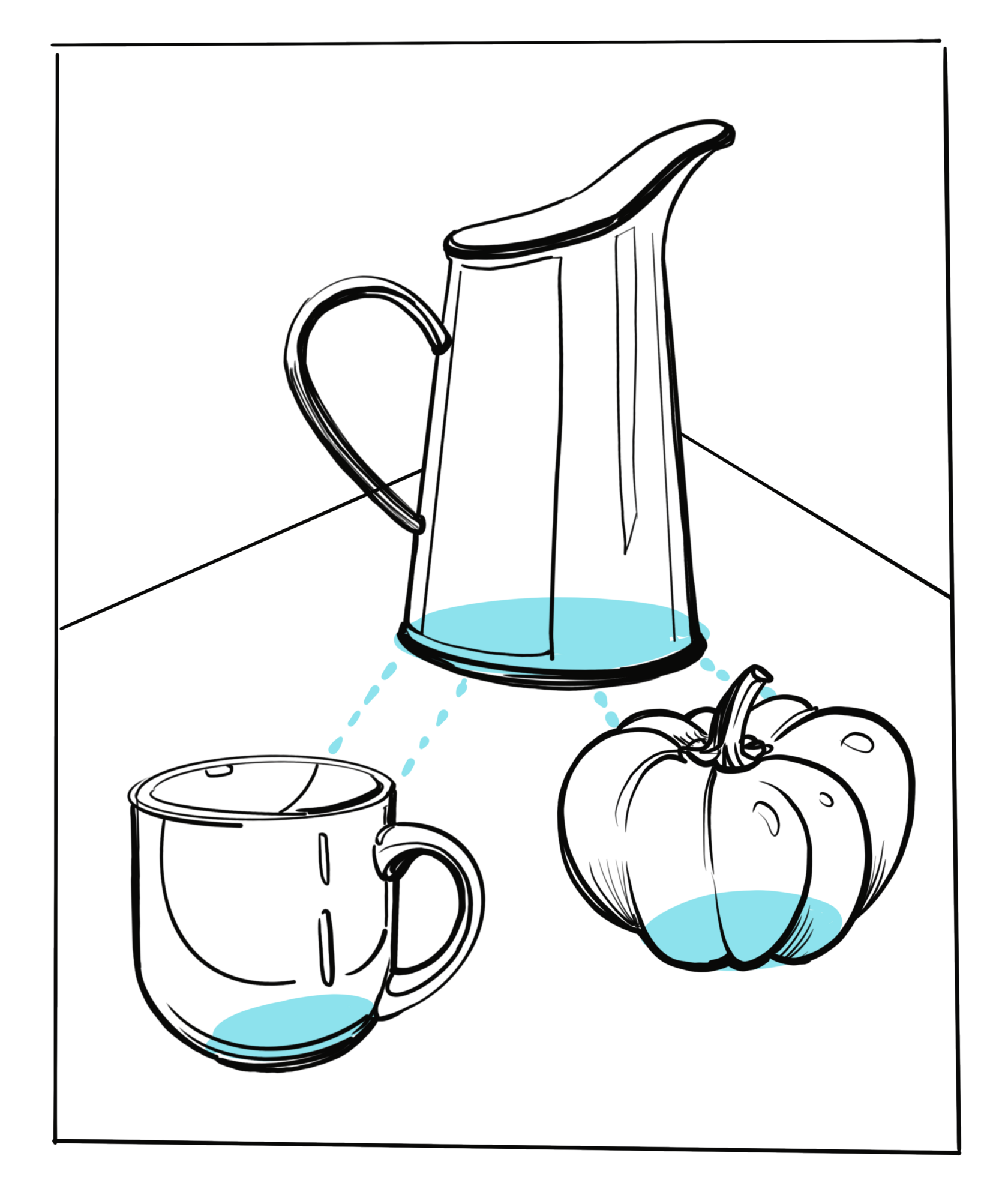
This is a useful approach when you want to create a sense of space without overcrowding the drawing.
Another option is to let objects partially overlap.
When an object in the foreground hides part of an object behind it, the viewer can immediately understand which is closer and which is farther away. Overlapping helps convey spatial depth and perspective, even in a simple still life.
Another option is to let objects partially overlap.
When an object in the foreground hides part of an object behind it, the viewer can immediately understand which is closer and which is farther away. Overlapping helps convey spatial depth and perspective, even in a simple still life.
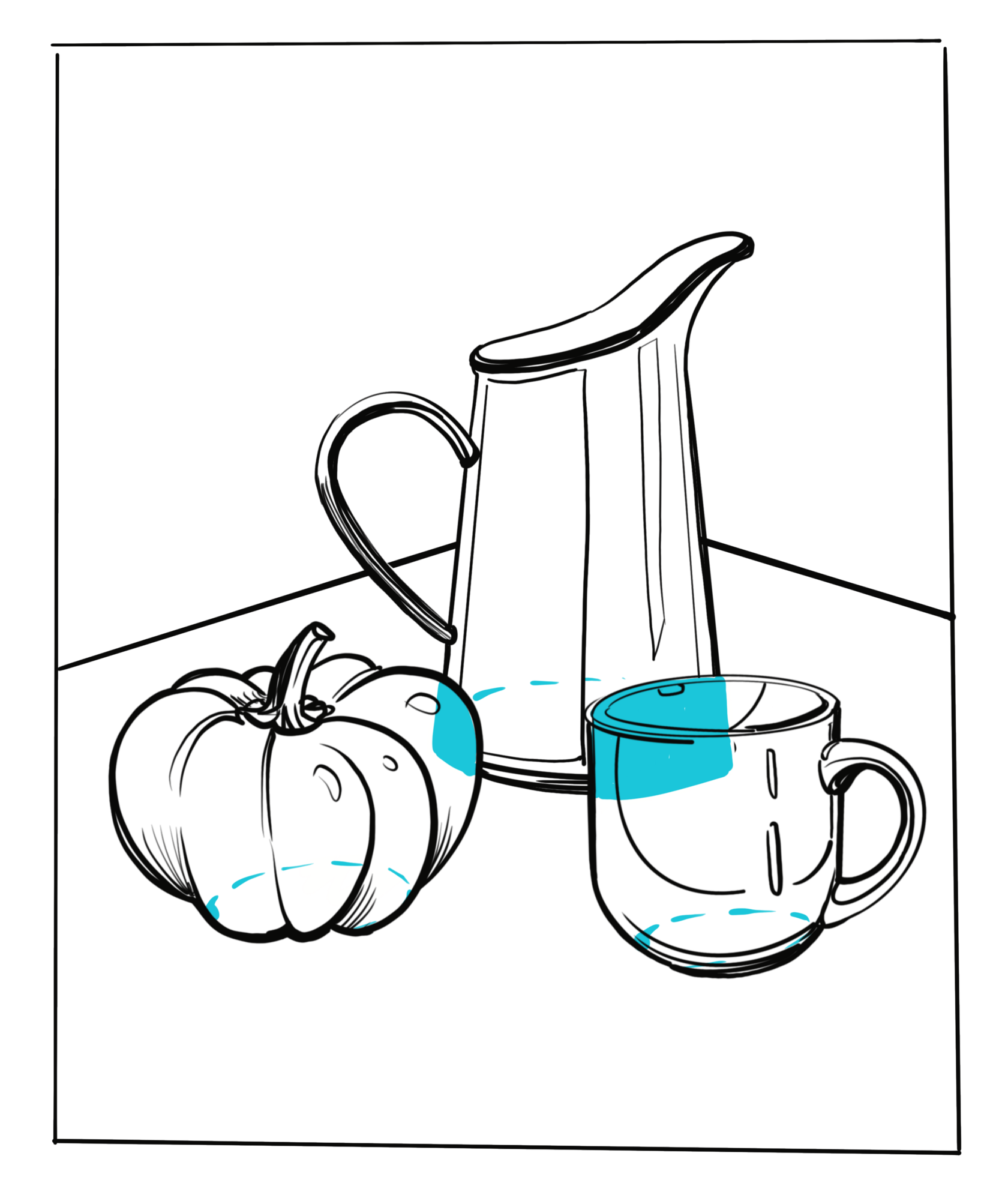
Compare the two approaches: in one, the objects appear almost independent of one another; in the other, they form a connected compositional group.
Create Groups of Objects
Another important principle of composition is to avoid spacing every object perfectly evenly.
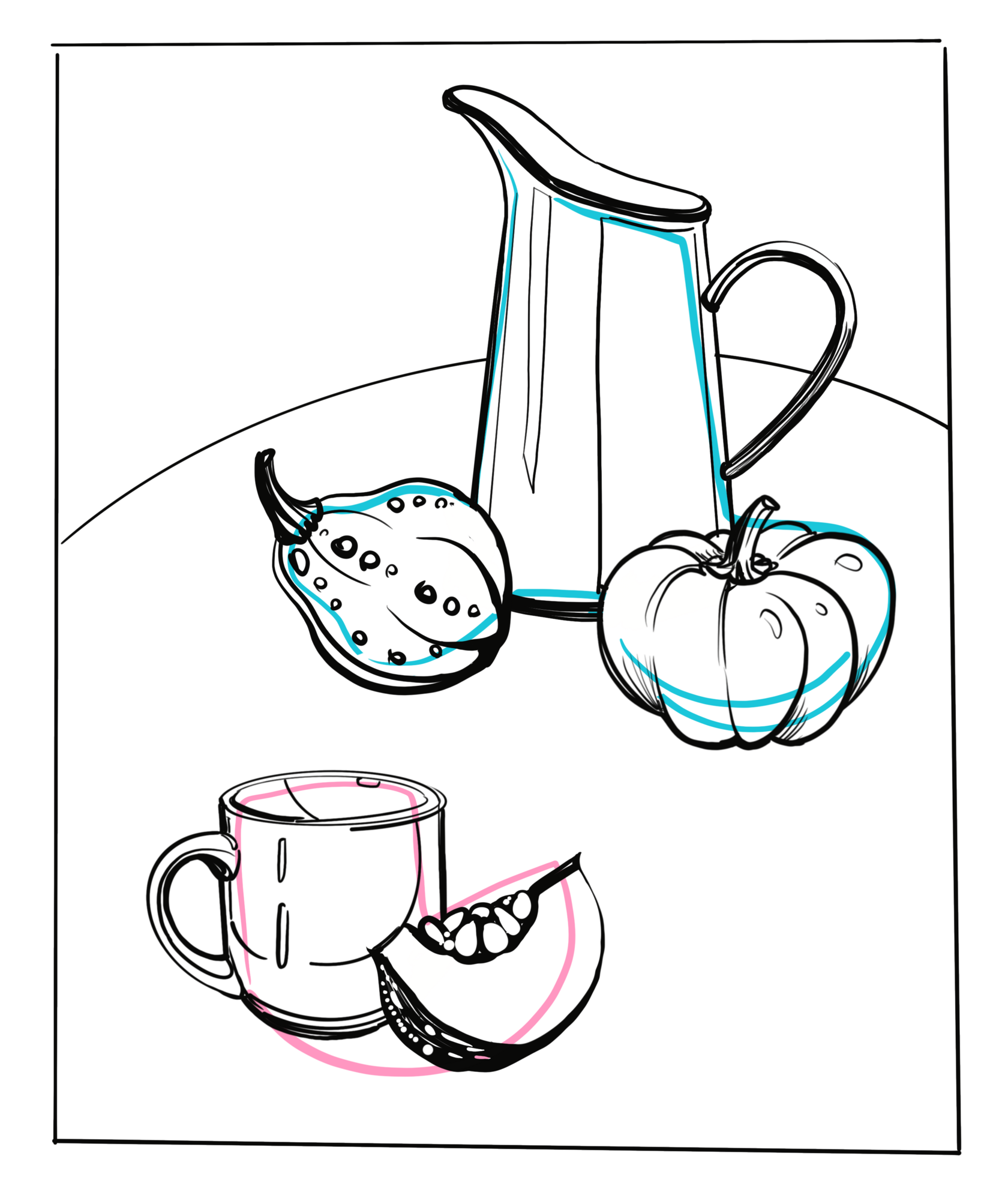
Creating compositional groups often produces a more interesting result.
For example, you could group a large pitcher with two smaller objects, then place the cup and a cut piece of a vegetable in a separate, smaller group.
Even with the same set of objects, there are many possible arrangements.
For example, you could group a large pitcher with two smaller objects, then place the cup and a cut piece of a vegetable in a separate, smaller group.
Even with the same set of objects, there are many possible arrangements.
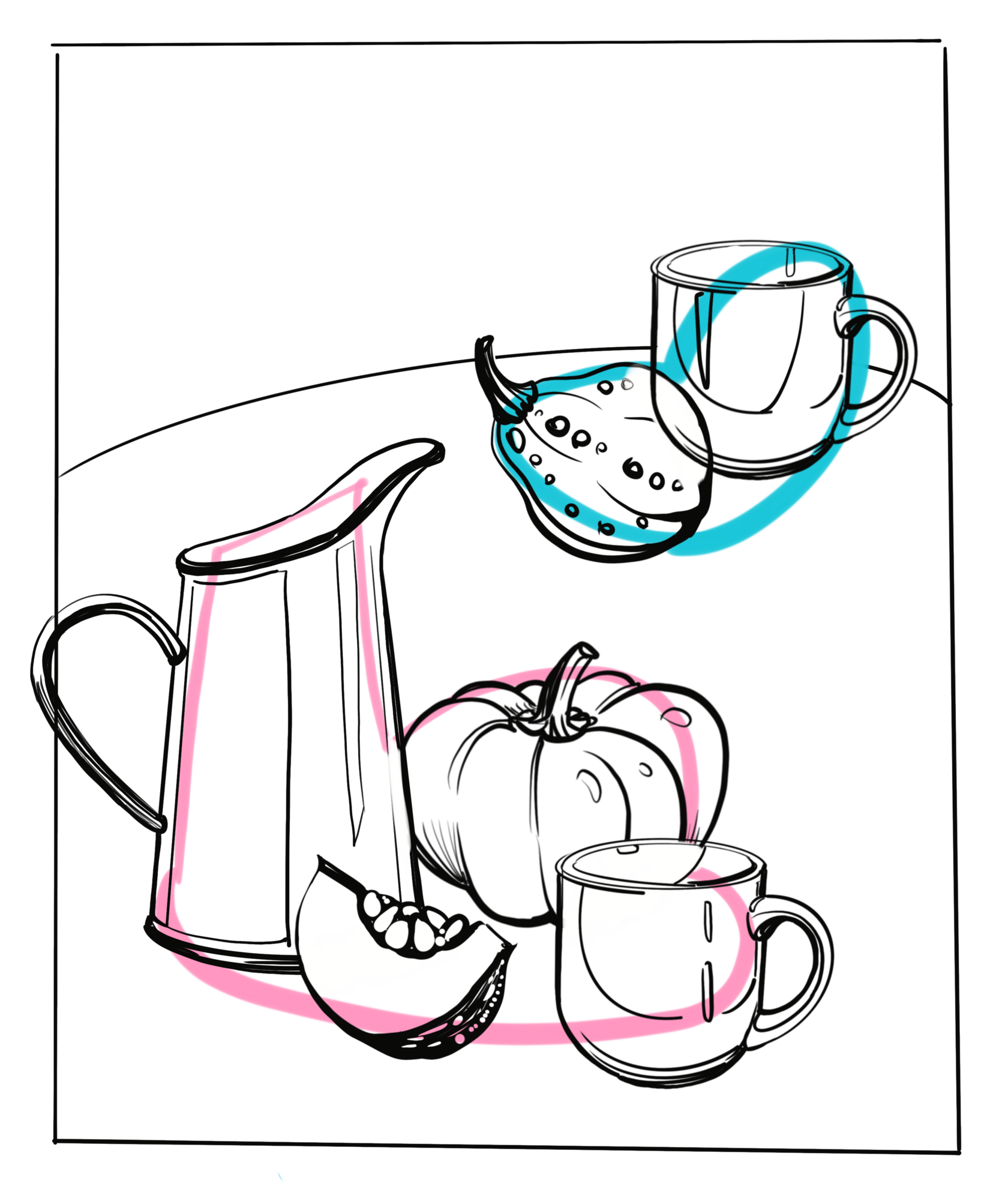
This is one of the most enjoyable parts of the process: there is no single “correct” arrangement. You can move objects around, adjust the spaces between them, and look for a balance that supports your idea.
The key is to make the objects relate to one another rather than appear randomly scattered across the page.
The key is to make the objects relate to one another rather than appear randomly scattered across the page.
Use Objects of Different Sizes
If all the objects are approximately the same size, the composition can become predictable.
Try varying their scale.
Try varying their scale.
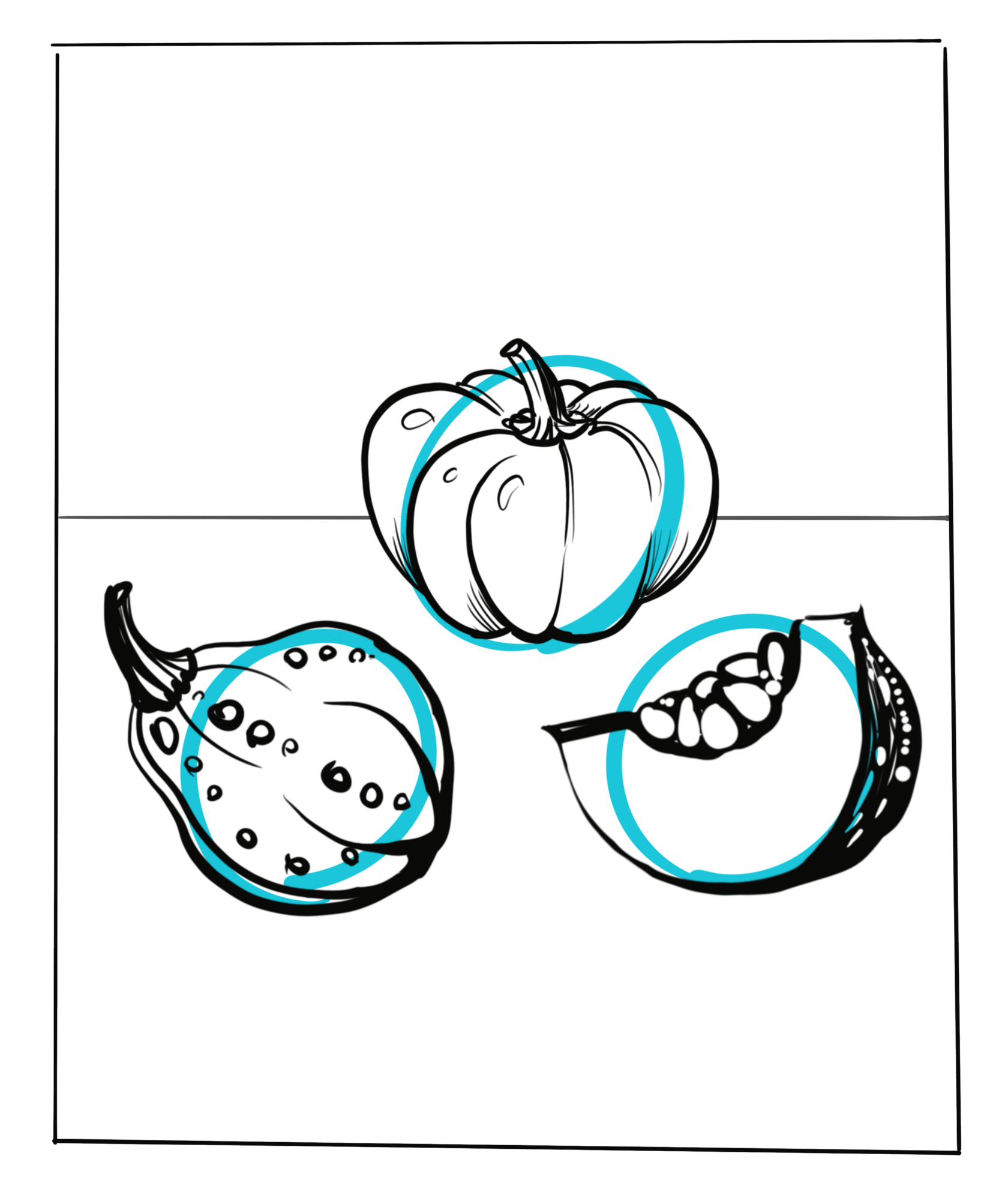
You can make one object larger to establish it as the main focal point, while keeping the others smaller and giving them supporting roles.
For example:
For example:
- A large object creates the main focal point.
- A medium-sized object supports the composition.
- A small object adds rhythm and variety.
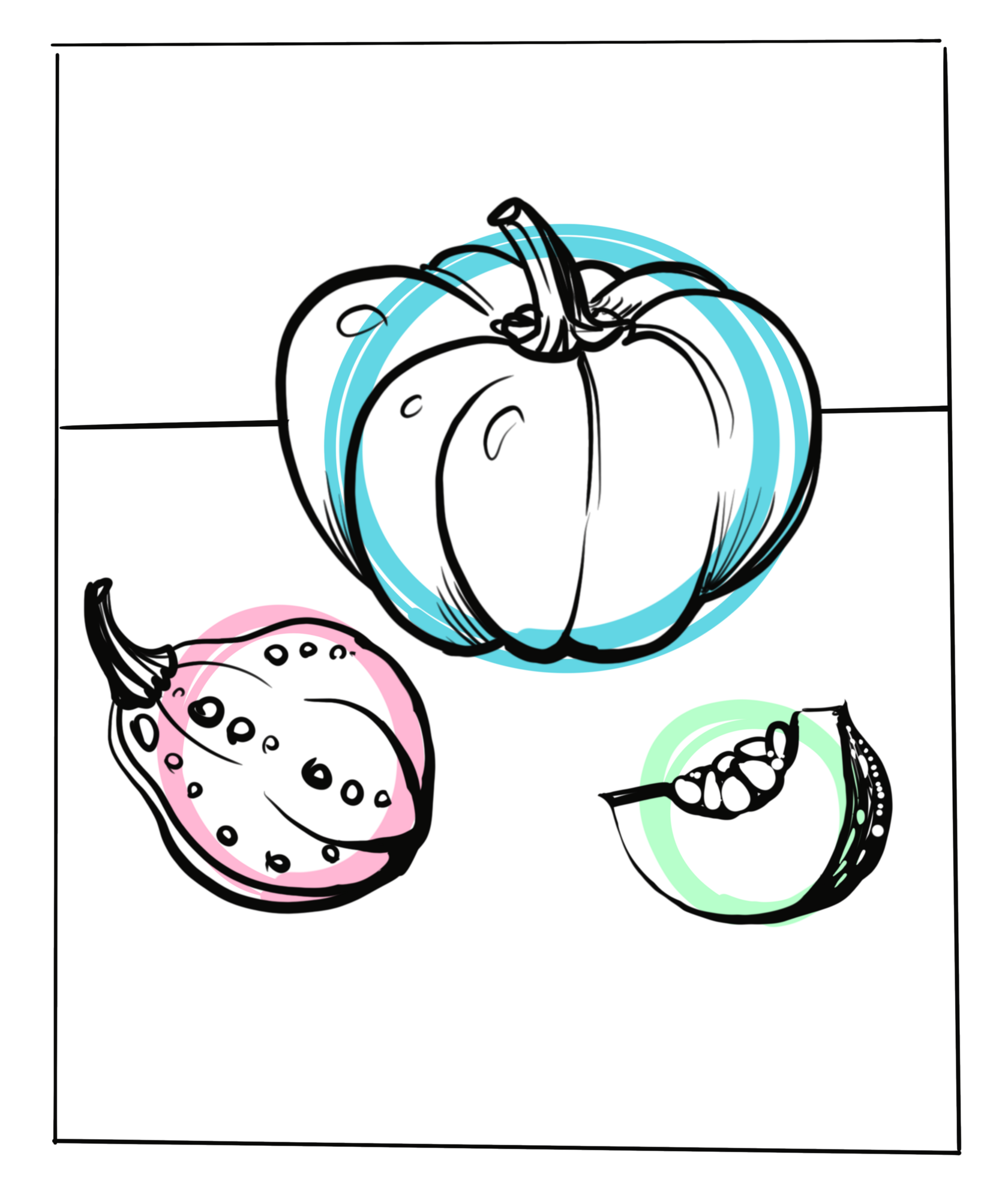
Differences in size help establish a visual hierarchy. The viewer can immediately sense where to look first and what to explore next.
Art thrives on variety, and scale is one of the simplest ways to introduce it.
Art thrives on variety, and scale is one of the simplest ways to introduce it.
Avoid Accidental Tangencies
This small detail can make a significant difference to how polished a composition looks.
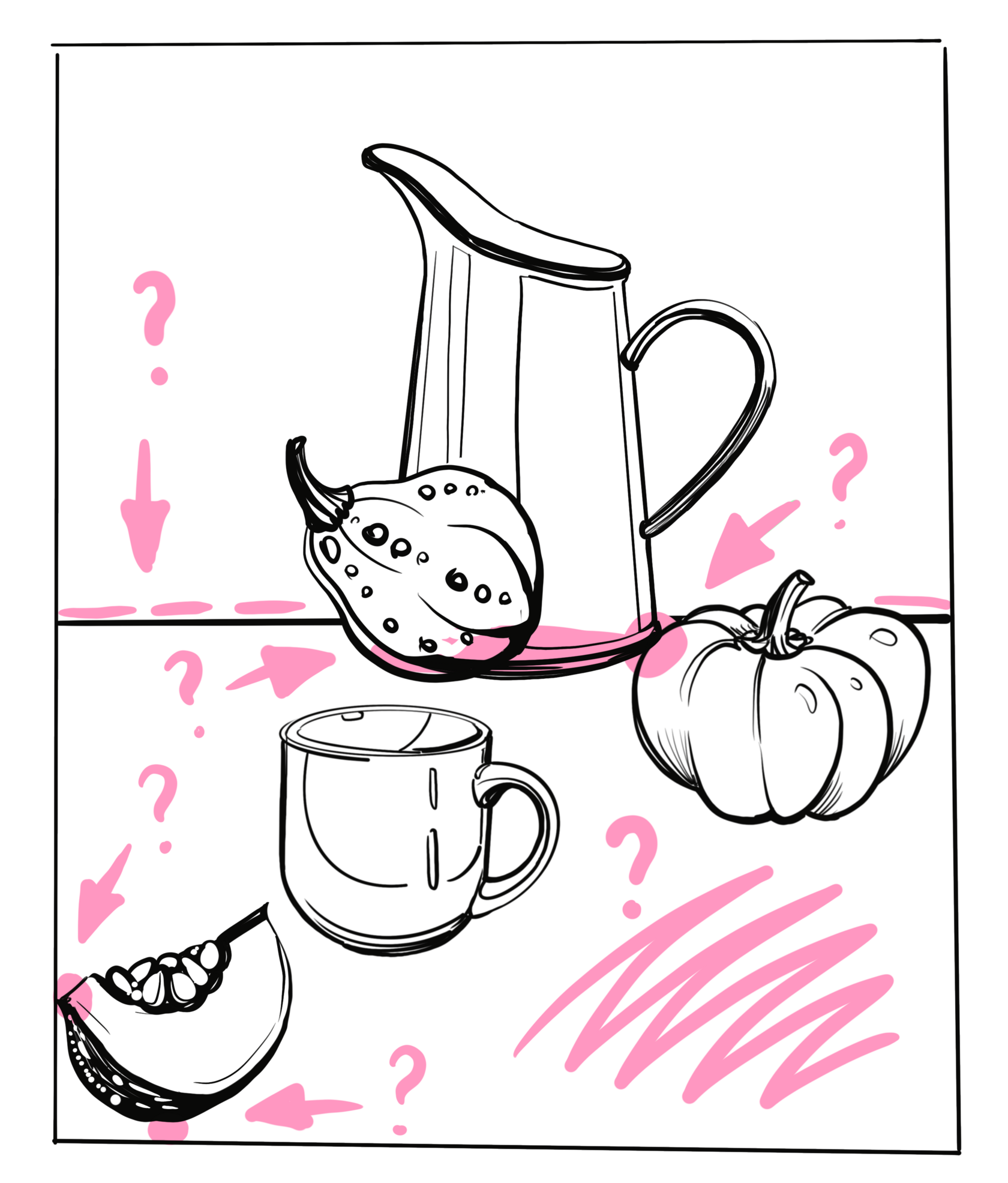
Check your drawing for unintended points where:
These alignments often create visual tension, even if the viewer cannot immediately explain why the composition feels awkward.
- Two objects barely touch.
- One object’s outline accidentally aligns with another.
- An object almost touches the edge of the page.
- The edge of an object aligns exactly with the horizon line.
- A very narrow, unclear gap remains between objects.
These alignments often create visual tension, even if the viewer cannot immediately explain why the composition feels awkward.
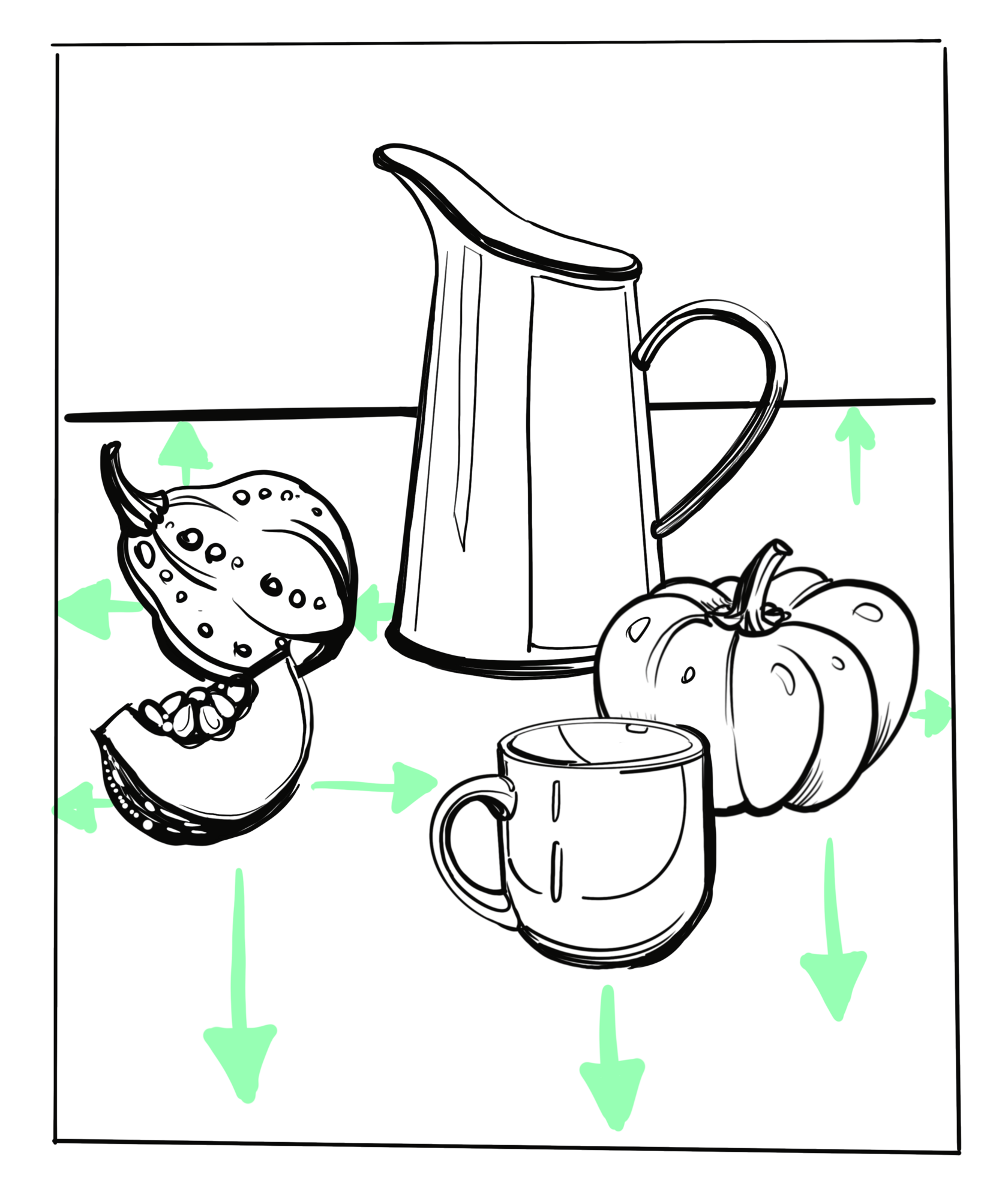
The placement of objects should feel intentional, rather than accidental.
Sometimes, simply shifting a cup, a vegetable, or the horizon line slightly is enough to make the entire composition feel much cleaner.
Sometimes, simply shifting a cup, a vegetable, or the horizon line slightly is enough to make the entire composition feel much cleaner.
How to Build a Strong Still-Life Composition: A Quick Checklist
Before moving on to detailed drawing, check your composition:
Don’t rush straight into the details. Spending a few minutes exploring the composition at the beginning can significantly improve the final result.
Compositional thinking matters beyond still life. The same principles of balance, scale, placement, and emphasis also apply to portraits. To continue practicing, explore our step-by-step guide, “How to Draw a Woman’s Face: Front, Profile, and Three-Quarter Views.”
- Is there a main object or focal point?
- Is the composition symmetrical or asymmetrical, and does that choice support your idea?
- Is there enough breathing room between objects?
- Are you using overlaps to create depth?
- Could you bring objects together into compositional groups?
- Do the objects vary in scale?
- Are there any accidental tangencies between outlines?
- Do any objects appear to “stick” to the edges of the page or the horizon line?
Don’t rush straight into the details. Spending a few minutes exploring the composition at the beginning can significantly improve the final result.
Compositional thinking matters beyond still life. The same principles of balance, scale, placement, and emphasis also apply to portraits. To continue practicing, explore our step-by-step guide, “How to Draw a Woman’s Face: Front, Profile, and Three-Quarter Views.”
Is There One Correct Composition?
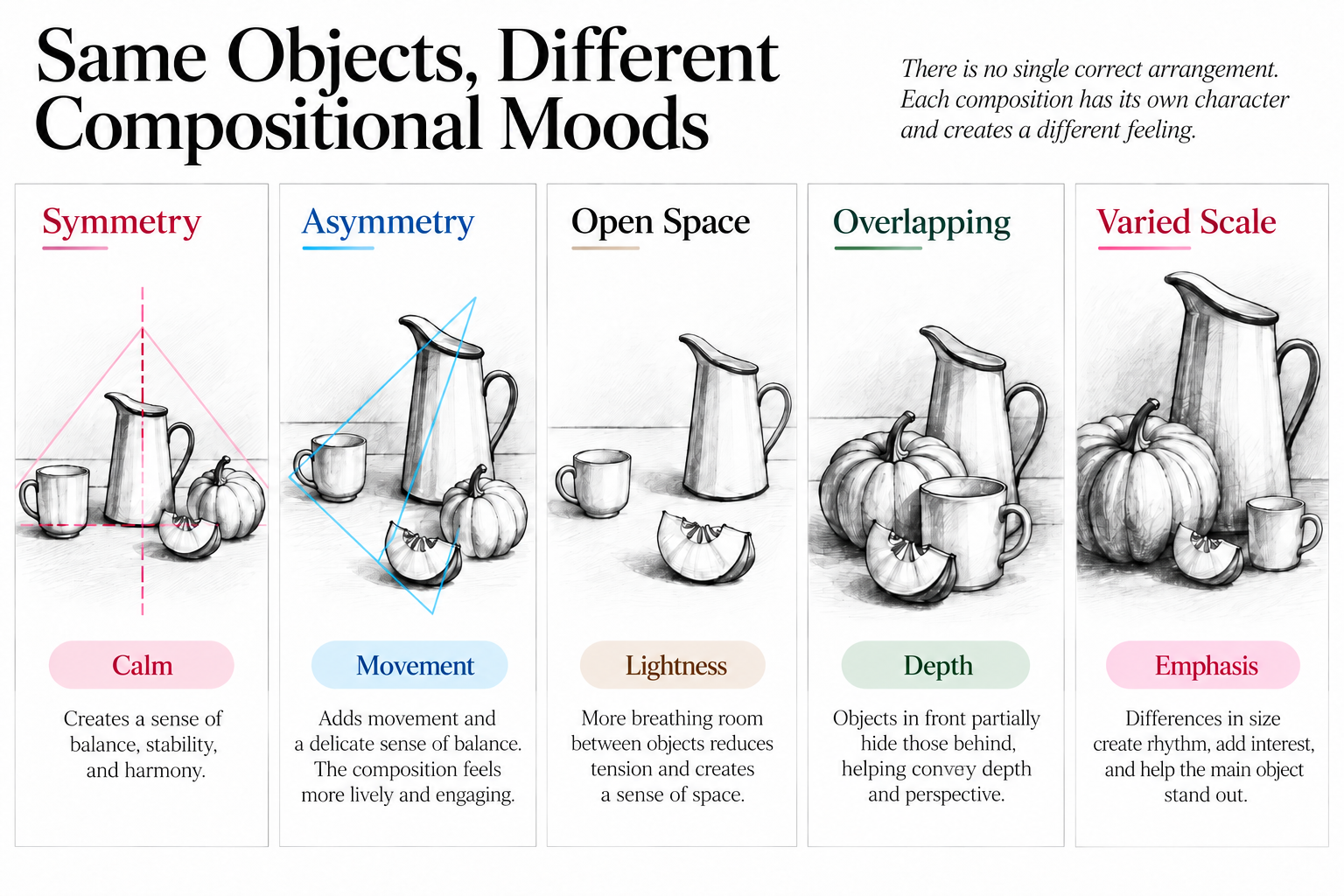
No. You can arrange the same set of objects in dozens of ways, each with its own character.
Symmetry can create calm.
Asymmetry can suggest movement.
Open space can create lightness.
Overlapping can add depth.
Variations in scale can establish emphasis and rhythm.
Composition is therefore not a set of rigid rules. It is a collection of tools artists use to guide the viewer’s attention.
Symmetry can create calm.
Asymmetry can suggest movement.
Open space can create lightness.
Overlapping can add depth.
Variations in scale can establish emphasis and rhythm.
Composition is therefore not a set of rigid rules. It is a collection of tools artists use to guide the viewer’s attention.
How to Develop an Eye for Composition
The best approach is regular practice. Choose three simple objects, such as a cup, a bottle, and a piece of fruit, but don’t begin your final drawing straight away.
First, make several small sketches:
Compare them. Even this simple exercise will gradually develop your compositional thinking.
If you’re just starting to draw and want to understand the basic stages of creating an image, read our guide, “How to Draw Anything: A Beginner’s Guide.” It complements this introduction to composition and helps you work from overall shapes towards finer details.
First, make several small sketches:
- A symmetrical composition.
- An asymmetrical composition.
- An arrangement with generous spaces between objects.
- A composition with overlapping objects.
- A composition with variations in object size.
Compare them. Even this simple exercise will gradually develop your compositional thinking.
If you’re just starting to draw and want to understand the basic stages of creating an image, read our guide, “How to Draw Anything: A Beginner’s Guide.” It complements this introduction to composition and helps you work from overall shapes towards finer details.
Want to Move Beyond Copying and Learn to Compose with Intention?
Composition is one of the topics students explore in Fantasy Room’s Drawing for Beginners course. Through step-by-step video lessons, you’ll study shape, volume, perspective, light and shadow, and composition, so you understand not only what to draw but also why certain arrangements work better.
The Pro plan also includes personalized homework feedback from your instructor. Submit photos of your drawings to receive written comments and visual corrections directly on your work, helping you recognize mistakes and understand how to improve.
You can put these composition techniques into practice and receive guidance on balance, scale, overlapping, and object placement in your own drawings.
Join Drawing for Beginners and learn to build your compositions with confidence and intention.
Frequently Asked Questions About Composition in Drawing
What Is Composition in Drawing?
Composition is the organization of all the elements within an image. It determines the placement, scale, relationships, and balance of objects, as well as how the viewer’s attention moves through the drawing.
What Makes a Good Still-Life Composition?
A good composition supports the artist’s intention and feels visually balanced. Objects can form a symmetrical or asymmetrical arrangement, overlap, create groups, and vary in scale.
How Can I Make a Composition More Interesting?
Try changing the sizes of objects, creating groups, using asymmetry and overlapping, varying the amount of open space, and avoiding accidental tangencies.
Why Make a Composition Sketch Before Drawing?
A small preliminary sketch lets you quickly test the arrangement and balance of objects before investing time in detailed drawing.


